
Why Spikeless Climbing Matters for Your Trees’ Health
When you hire a professional to care for your trees, have you ever stopped to wonder how they actually get up there? It’s not something most homeowners think about—until they see someone scaling their beautiful oak or maple with metal spikes strapped to their boots. The truth is, there are two main ways arborists climb trees: with specialized ropes and harnesses (spikeless tree climbing), or with climbing spikes that puncture the bark with every step.
Here’s what every homeowner needs to know: while spikes have their place in tree work, using them to prune a living, healthy tree is harmful and goes against modern tree care best practices. If you value the long-term health and beauty of your landscape, understanding the difference between these methods could save your trees from unnecessary damage—and save you from costly problems down the road.
What Are Climbing Spikes? (And When Are They Actually Used?)
Climbing spikes—also called gaffs or spurs—are sharp metal spikes that strap onto an arborist’s boots. They work exactly like they sound: the climber literally stabs them into the tree trunk with each step upward, using the tree’s own bark and wood as a ladder.
Now, before we go any further, let’s be clear about something important: climbing spikes aren’t inherently evil. They’re actually a legitimate tool in the tree care industry—but only for one specific job: tree removals. When a tree is already slated to come down completely, and its health is no longer a concern, spikes are an efficient and acceptable way to climb. In that scenario, the tree’s fate is sealed anyway, so the puncture wounds don’t matter.
The problem starts when tree services use spikes for pruning, trimming, or any other work on a living tree that you want to keep healthy and thriving. Unfortunately, some companies still use this outdated approach because it’s faster and requires less skill and equipment. But faster doesn’t mean better—especially not for your trees.
The Hidden Damage of Spikes on Living Trees
Think of climbing spikes as hundreds of tiny, deep wounds inflicted on your tree. Every single step up and down the trunk creates another puncture. To understand why this matters so much, you need to know a little bit about tree anatomy.
Wounding the Cambium Layer
Just beneath a tree’s protective bark lies the cambium—a thin but vital layer that functions like the tree’s circulatory system. This is where water, nutrients, and sugars move up and down the tree, feeding every branch and leaf. When climbing spikes pierce through the bark, they drive deep into this cambium layer, creating wounds that compromise the tree’s ability to transport these life-sustaining resources.
Opening the Door for Pests and Disease
Every spike hole is an open invitation for trouble. These puncture wounds create perfect entry points for harmful insects, fungi, and bacteria that wouldn’t otherwise have access to the tree’s vulnerable inner tissues. Boring insects can exploit these openings. Fungal spores can take hold and begin the slow process of internal decay. Bacterial infections can spread through the tree’s vascular system. What starts as a simple puncture wound can become a gateway for disease that weakens or even kills the tree over time.
Stress and Energy Depletion
Trees are remarkably resilient organisms. When wounded, they work hard to compartmentalize the damage and seal it off—a process that requires significant energy and resources. Now imagine your tree trying to heal not just one or two wounds, but potentially hundreds of them from a single climbing session. All that energy being diverted to wound response is energy that can’t go toward healthy growth, producing leaves, or fighting off other stressors like drought or temperature extremes. It’s like asking someone to run a marathon while healing from multiple injuries—the body simply can’t perform at its best.
Long-Term Damage
On many tree species, especially those with thin bark like birches, maples, and beeches, spike wounds leave permanent scars. These dark, oval-shaped marks run up and down the trunk like a ladder of damage, compromising not just the tree’s health but also its aesthetic value. For homeowners who take pride in their landscape, these visible scars are a constant reminder of unnecessary harm.
The Professional Alternative: Spikeless Rope Climbing
Modern arboriculture has moved far beyond the crude approach of spike climbing. Today’s certified arborists who follow ISA certified arborist standards use sophisticated rope access tree work techniques that allow them to ascend and maneuver through a tree’s canopy without causing any damage whatsoever.
The Art of Rope Work
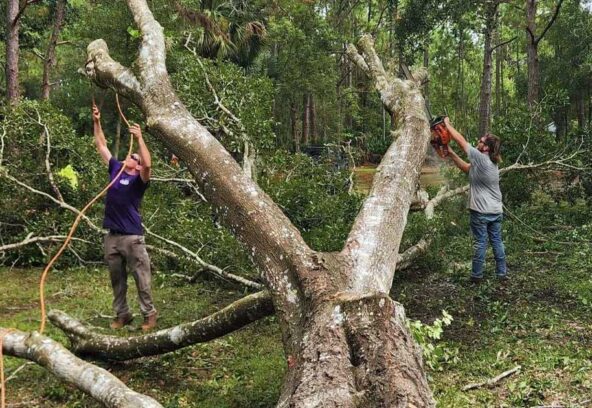
Professional tree pruning using spikeless methods is genuinely impressive to watch. Skilled arborists use a system of specialized ropes, friction hitches, carabiners, and harnesses to climb safely and efficiently. They throw a weighted line over a strong branch, secure their climbing rope, and ascend using techniques borrowed from rock climbing and refined specifically for trees. Once in the canopy, they can move from branch to branch, repositioning their ropes as needed, all while keeping their weight distributed properly and their tools within reach.
This isn’t just about avoiding spike damage—it’s a completely different level of craftsmanship that requires extensive training, practice, and investment in quality equipment.
Benefits of Spikeless Climbing
The advantages of rope climbing go far beyond just avoiding puncture wounds:
When you see an arborist working with ropes instead of spikes on a living tree, you’re watching someone who takes their craft seriously.
What to Ask Your Tree Care Provider
Now that you understand the difference, you have the knowledge to make an informed choice. Before hiring a tree service, protect your investment by asking these simple questions:
"What methods will you use to climb my trees?"
"Do you use spikes for pruning live trees?"
"Are your arborists trained in modern rope climbing techniques?"
"Can you show me references or examples of similar work?"
Don’t be shy about asking these questions. Any legitimate tree care service will welcome the opportunity to explain their methods and differentiate themselves from less professional competitors.
Your Trees Deserve the Best
The trees on your property are living investments. They provide shade that cools your home, beauty that enhances your landscape’s value, habitat for wildlife, and even cleaner air for your family to breathe. A mature tree can add thousands of dollars to your property value—but only if it’s healthy.
Protecting that investment starts with making sure the professionals you hire use techniques that prioritize long-term tree health over short-term convenience. Spikeless climbing isn’t just a fancy technique—it’s the baseline standard of care that your trees deserve.
When you choose a tree service that climbs spikeless, you’re choosing to invest in the long-term health and beauty of your landscape. You’re choosing professionals who respect both their craft and your property. And you’re ensuring that the trees that shade your home, frame your views, and anchor your landscape will continue to thrive for decades to come.
At the end of the day, it’s simple: healthy trees are the result of proper care from trained professionals who do things the right way—even when the right way requires more skill, more time, and better equipment. When hiring a tree service, make sure they’re willing to go that extra mile. Your trees will thank you for it.
Looking for a tree service that follows certified arborist standards and uses spikeless climbing techniques? Make sure to ask the right questions before you hire, and always verify credentials and insurance. Your trees’ health depends on the choices you make today.